

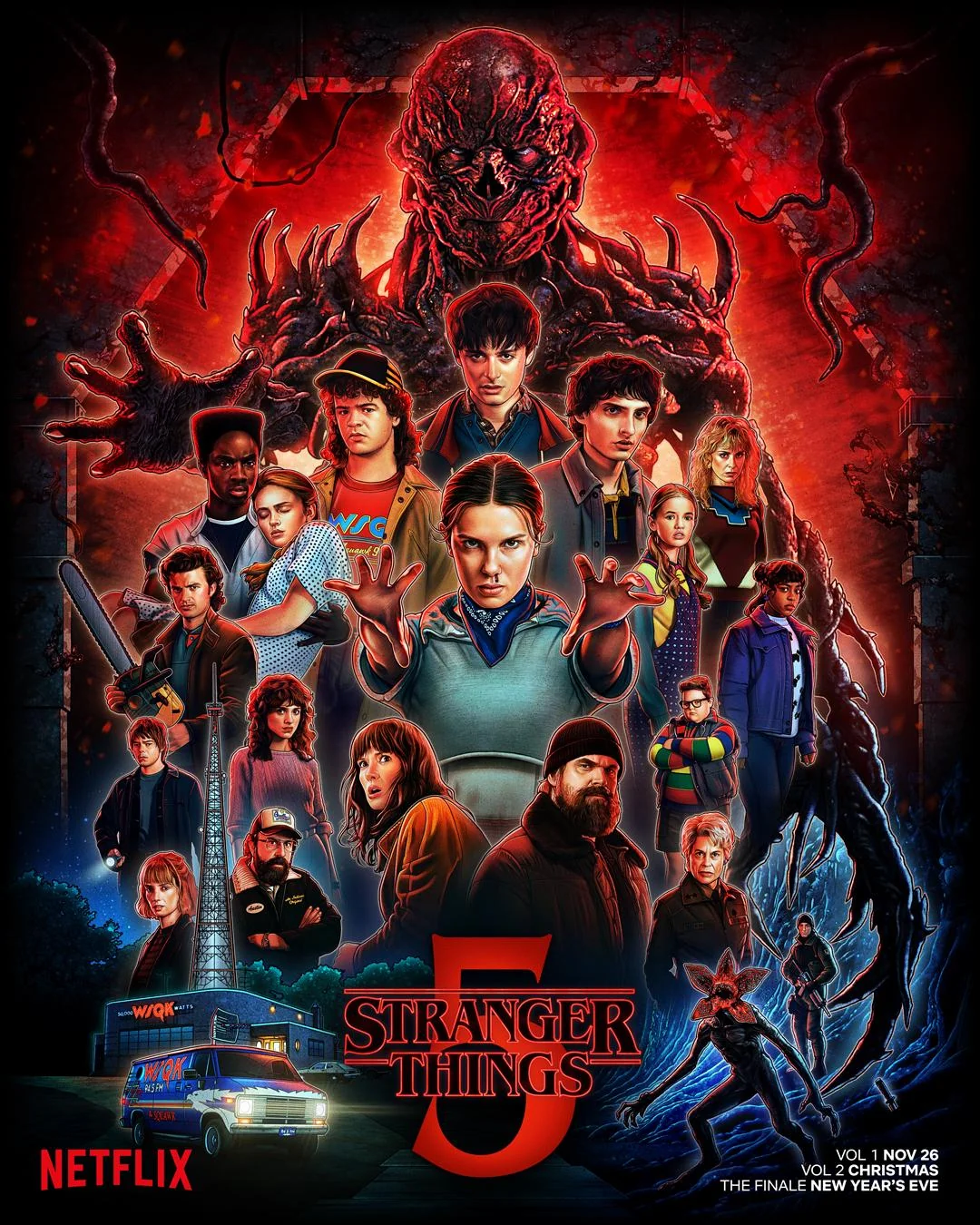
You know when the recap starts playing before the first episode (besides the fact that I was biting on my nails trying to recall what happened in the past four seasons from hundreds of years ago), and suddenly your eyes are brimming with lacrimal fluid for no logical reason? Yeah. That was me.
Last month, I finished watching Volume I of Season 5 of Stranger Things. Dustin begging to get bullied. El discovering even more peculiar ways to jump across different heights. Hopper growing his beard to at least ten times its former length. Nancy somehow looking prettier with every episode—though this season she remained a quiet monster lurking on the sidelines, with little to no substance or storyline of her own. Will’s goosebumps becoming noticeably goozier. And last but not least, Steve mastering yet another season of good, fluffy hair. Hair so beautiful, it could make any girl, of any age, fold instantly.
But my relationship with this franchise isn’t newfound. This isn’t a casual fling. It’s been a close-knit, slightly unrequited bond ever since I discovered the show during COVID, back when I was in middle school. So watching it inch toward its end feels like aggressively shaking a sewing machine while the fabric slowly slips out of place. Seeing the characters finally stumble toward their endgames, without fully maturing into them, and watching those once-plum cheeks fade doesn’t just make me want to cry. It also fills me with an intense wave of nostalgia and a burning curiosity for what’s coming next, as the final episodes roll out and march us toward the finale.
So yes, as an avid Stranger Things fan, fantasizing, overanalyzing, and forming unique conspiracies about what happens next feels only natural. But I’m not just here to speculate plot twists and production choices. I’m here to think about what those choices could cost.
Season 5 is peaking right now. Fans are louder, more emotional, and more wildly speculative, than ever before.
And when that happens, you know where everyone goes.
TikTok & Instagram.
A place where fans churn out endless edits, spark trends, and flood comment sections with all their fear, devotion, and emotions. Such as this one:

But out of all the chaos, one discussion caught my eye: the growing panic around the ending. What if it involves time travelling? What if it turns out that the entire series was a dream or a delusion fabricated in the mind of a disadvantaged or disoriented character? Or worse, what if it was all just an stupid D&D game, where the boys were so deeply immersed that reality simply… slipped away?
On the flip side, a more backhanded question was concerning me: what could that mean economically for the Duffer Brothers, if they commit the ultimate storytelling sin? Like, how much money could be lost if fans feel betrayed and stop recommending the show? What’s the amount of bill Netflix has to pay if they mess up, badly?
So, for those emotionally invested, sci-fi nerds and movie buffs, looking for answers — here’s my take.
Consumer Trust Erosion, Loss Aversion, and Why Steve & Dustin Should Fix It Between Them Before It Gets Too Far
It was only some time ago that I last heard of someone buying in bulk from SHEIN. And there was a time when I, myself, bought so much from SHEIN that I could comfortably declare myself an addict.
Then headlines started surfacing online—about SHEIN owning sweatshops and endorsing child labor within their firm. Allegations of low wages and illegal working hours spread rapidly across the internet, and the company began facing severe backlash.
Down the line, my wishlist filled up with clothes and built itself high, almost sanctimoniously, but the items were never taken out of the cart. Something kept me from clicking that “CHECKOUT” button. Something kept me from eventually opening the app at all.
And that something was—trust.
As a loyal customer, I often felt tempted to buy from SHEIN every chance I got. In fact, I even did. And while it may have looked like I was splurging money on overconsumption, that wasn’t the issue that poked me. First—because I feel like I didn’t. And second—because it wasn’t the primary reason that discouraged me from buying from SHEIN or recommending it to others who had yet to discover it. That’s consumer trust erosion.
Even if the backlash didn’t immediately reflect as a sharp dip in revenue, SHEIN still faces ongoing public scrutiny; the scrutiny that lingers in its image and online presence. It serves as a reminder of how a single misstep or unhinged change in operations can alter the trajectory of a firm. More importantly, it shows the critical role consumers play in the market. Letting them down in any way can drastically affect growth because, at the end of the day, decision-making power and profit generation lie—significantly—in our hands. The consumers’ hands.
Thus, weakening consumer confidence through egocentric or dismissive practices can be deeply detrimental to a firm’s long-term health.
Now, how does this tie into Stranger Things?
Surprisingly well.
I came across the following comment under yet another edit of Will’s big reveal in the final episode of Season 5, Volume I:
“Imagine this whole time they were just playin D&D and none of this happened AND THE LAST EPISODE IS MIKE’S MOM YELLING AT THEM TO COME UPSTAIRS — I would CRY.”
— random internet user
And many others seconded it. Not just under that post, not just under that one idea, but across countless threads and comments. It made one thing clear to me: the power does, in fact, lie largely in the hands of the consumer. Demand is what ultimately shapes a firm’s curves on graphs.
On the same note, this is where loss aversion quietly creeps in as well. As Kahneman explains, “The response to losses is stronger than the response to corresponding gains”.
Fans aren’t just afraid of a bad ending, they’re afraid of losing everything they’ve emotionally invested in for years. I mean I, for a fact, would be upset if I discover that all this time this show was just a game of DnD simulated in real life. Watching characters struggle, grow, and survive only for it to be short cut by a stupid narrative feels less like closure and more like erasure.
So if Stranger Things fails to meet the expectations of its massive audience and instead remains rigid in its own narrative choices and plot twists (much like Dustin, an irritable hose in the nose, whose obstinate attitude often creates discord and distrust between him and Steve), then nothing can stop the erosion of consumer trust and loyalty. That decline would translate into lower new viewer acquisition, reduced rewatch value, diminished lifecycle revenue, negative word-of-mouth externalities, and essentially, the unraveling of everything that once made this show the supernova that it is.
Which brings me to what follows: what this loss would really look like.
Brand Equity Loss: Mike’s Mom Yelling or Henry Going Back To Normal Would Pull the Last Straw
Starcourt Mall, Eggo waffles, Kate Bush, shaggy mullets, bikes, walkie-talkies—Stranger Things didn’t just reference the ’80s; it curated it. The show portrayed an era so effectively that it became a spotless gem, loved across generations. It created a kind of nostalgia so vivid that even people who never lived through the decade feel drawn to it, despite gaps in culture and styles.
That ability to tap into emotion at exactly the right moment and tie mood to memory is the core of Stranger Things’ brand. But when a brand isn’t nurtured the way it should be, when it begins to lose the elements that truly connect viewers to the story, its intangible value starts to erode. And when that happens, the brand loses the very power that once shaped its place in the market, and in culture itself.
What that means for this show? If Mike and his friends are revealed to be playing a DnD simulation game at the end of the series (as discussed earlier), or if Henry turns out to be merely a projection from El’s past that feeds into a time-travel narrative, and none of this is actually real, the erosion of the extra value that adds to the brand name becomes inevitable.
According to Investopedia, “Brand equity refers to the value a brand adds to a product, affecting how much more a customer is willing to pay compared to generic alternatives.” Which basically means that if you’re obsessed with bags, and for you, Prada, Chanel, Balenciaga, or Louis Vuitton are the ultimate choices, that preference isn’t just about material quality or where the product is made. It’s about the name and the image the brand holds. And why do they have that image in the first place? Because of us—consumers.
Consumer perception plays a very important role in shaping a brand’s face. It affects how both its tangible (revenues and profits) and intangible (awareness and cultural welfare) values turn out—whether positive or negative. In the context of Stranger Things, the fans are what made it such a massive hit. And why? Because we liked the story.
So if Stranger Things suddenly decides to turn the story Upside Down, for the worse and only the worse, a disappointing ending will cause it to lose its cultural prestige. Which means lower future earnings, lower long-term sales, and lower binge value. And lower binge value means fewer people talking about it. Or perhaps more people will talk about it, but in a way that’s purely critical and negative.
Which brings me to how Stranger Things’ loss could become Netflix’s loss, at scale. No exaggeration, no jargon. Just pure facts.
The Spillover Effect: Stocks can jump higher than El
Not to rage-bait or anything, but stocks can indeed take a bigger leap than you can or ever will, El, if the Duffer Brothers don’t get their act together. (This reminds me of Episode 1 of this season, where she kept pushing herself toward “perfection” by jumping over high sleds and hurdles, despite Hopper warning her about getting hurt or injured.) But you know what could get even more injured if that leap turns into a switch between timelines and people start slagging it off?
When one true fan is disappointed with the plot and starts speaking ill of it, and another joins in, that creates a ripple. When more people begin criticizing than admiring something, collectively, it causes a spillover effect: unintended externalities that spread into seemingly unrelated areas, ultimately impacting the overall outcome.
Picture this: the Stranger Things finale releases; massive backlash follows; viewer ratings decline; Netflix forecasts subscription slowdowns; negative headlines surface; Netflix’s quarterly performance weakens, and the stock dips.
While most of this may not come true, even if the effect is trivial or temporary, it is still a real financial impact.
If a consumer base is hijacked by continued disenchantment and widespread dissatisfaction, sustaining the producer–consumer bond becomes increasingly difficult. And I’ll keep repeating this till the end: consumers shape the fate of firms. The power ultimately lies in the hands of the public, whether we like to admit it or not. Because running a business or producing a product that no one wants to buy is meaningless.
As this begins to hinder sales, revenues, and profits, a firm’s market share within that specific niche can decline. And since Netflix is home to Stranger Things, the platform that owns it, even a mere ripple in the show’s earnings or brand equity could spill over into Netflix’s market position. In response to that fallout, its stock could very well take a bear turn.
Stock markets don’t react to what has already happened; they react to what investors fear might happen next. Because, when investors wake up tomorrow and notice the negative remarks about Netflix’s loss on one of their biggest, most profit generating product, on the front page, the response to that is not going to be much in favor of the firm.
We have seen this before: entertainment firms facing backlash often experience short-term volatility as investor confidence declines. Take for example, Disney’s current status in the stock market (not to mention, its been a joke lately), where among many reasons for investor confidence decline, one stood out prominent — creative direction.
Many critics and audiences argued that Disney’s recent live-action projects were “Soulless” and “Lacked Originality”. Which is to say, they miserably failed in their attempts to subvert original characters and storylines that once had the audience watching on loop.
While this is not exactly what’s concerning with Stranger Things’ narrative or Netflix’s production choices, they still share the repercussions: you play with your viewer’s emotions, you pay a bill more expensive than what it took for you to build the whole flesh wall.
The Much Awaited Reaction — Here’s My Prediction
Yes, I am one of the those million consumers (your audience) who has the ability to decide your fate, well — both logically and figuratively.
Hence, taking in account of all that I ranted about so far, my prediction doesn’t just lie in the behavioral side or is just an analysis of the convolutions of a firm’s decisions. A financial prediction, although just a prediction — a rough estimation — is a must. While Stranger Things does not publicly disclose its financial data separately from Netflix’s corporate earnings, here’s some over-the-top estimations that I have found online:
- It generates just over $1 billion in global streaming revenue for Netflix since 2020. The show is estimated to have contributed around $120 million in streaming revenue per quarter.
- It is responsible for more than 2 million new Netflix subscriber sign-ups worldwide.
- In October, Stranger Things Season 5 reportedly cost $50–60 million per episode — among the most expensive TV production budgets ever. So if Season 5 releases 8 episodes, in total, that’s roughly $400 million–$480 million just in production cost.
Now, taking a Peek at Netflix’s financials, which is of course widely available across the internet, the following things are evident:
- Although Netflix executed a 10-for-1 stock split to make shares more affordable and broaden investor participation, long-term stock performance will be driven by Netflix’s operating results and business fundamentals, not just the split itself.
- Although according to multiple stock screeners, their Revenue is around $39 billion and net income is around $8.71 billion, beating analysts’ expectations, if big engagement drivers like Stranger Things are resistant of continued growth and accessibility, a reduction in future growth expectations, even if minor, can tank investments.
So, considering Stranger Things contributes 3–6% of Netflix’s annual value, assuming backlash causes 10–20% decline in Stranger Things’ long-term value, the Net loss will be around 0.3% – 1.2%. Which means if Netflix is earning $39 billion in revenue, the loss, although not immediate, will account to approximately $117-$468 million. Proving how a simple shift in sentiment can cause shift in future growth and valuation on paper.
The shift may not result in the collapse of the platform, but a modest decline in the show’s long-term pull could translate into hundreds of millions of dollars in lost value for Netflix — not overnight, but gradually.
Nevertheless, despite all these speculations, until the finale and until the major character death reveal, my heart pounds for this show like it always has. As a result, that naturally motivates me to warn the Duffer Brothers against making any big decisions and to prevent them from going off the rails: “PAPA! PAPA! Don’t go there. Don’t do it. Just don’t do it. Let it go as it’s going. Don’t upset us by flipping time… I mean the dimensions… uhh, I mean the pages,” in El’s voice. “And please don’t kill Steve, for God’s sake!” I whisper.

Comments
4 responses
I thoroughly enjoyed your take. I am waiting how the finale would turn out.
I remember the last time I was this excited was the Game of Thrones season Finale and what an epic disappointment that was!
Hey! Thanks for your kind words and for taking the time to read this post. Also, I just finished watching the finale and honestly, it wasn’t that bad. I mean the ending definitely made sense but I personally wish there was more to it. I just really hope that Mike’s theory is in fact real. Else the show would be a another step closer to gaining similar backlash as the Game of Thrones, which was indeed a disappointment.
I’ve watched only the first season and am not much of a fan of the series. The S5 hype these days brought me here and despite not being aware of what the storyline has become, I loved reading this piece, especially your conversational and engaging tone. I too believe that a bad ending is more than just a disappointment. It’s a massive financial risk.
I might come back for for your future writings. (I’m a writer myself so I really appreciate it when someone has a such unique and interesting take on an otherwise popular topic)
I am glad you were able to satiate your curiosity for the trending discussions that were going around for a while now, by taking the time to read my post. I will be posting another blog soon on another interesting topic so stay tuned! Thank you 💗